
Still On The Steps

We chase ghosts.
The faint glimpse of what we never heard. What we didn’t get as a child becomes the thing we crave most when we are older. It becomes an ache we don’t know how to ease. What we crave becomes carved. Deeply etched into how we love.
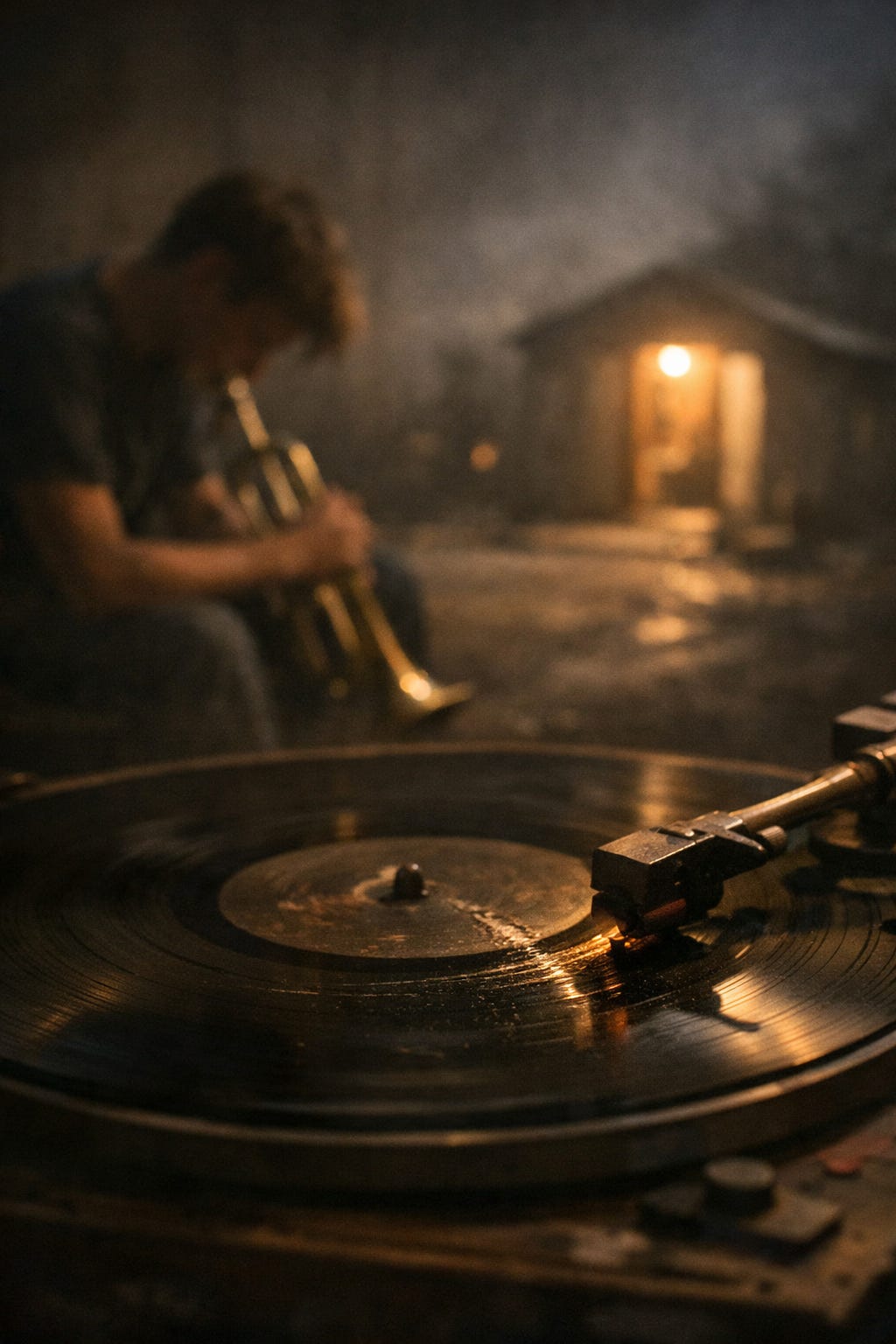
On a vinyl record, the sound is stored in the tiny grooves. The music plays from the cuts. Sometimes the record gets damaged and instead of moving forward it gets stuck in a loop. Playing the same section over and over again.
The Same Tired Song
In the 9th grade, I had a trumpet solo in our marching band’s halftime performance. It was a big deal, especially as a freshman. I was proud of it. I wanted my parents to be proud too.
That same game, we played a team with a similar halftime show. Someone on their side played the same solo.
On the ride home, my parents talked nonstop about how good their performance was.
They never mentioned mine.
The song repeats.
The summer after that moment, I started practicing for hours every day. I would play until the outline of the mouthpiece was engraved into my lips. I would go out to the shed in the middle of summer and practice until sweat ran down my face and pooled on the floor.
I wasn’t just trying to get better. I was trying to be seen.
I wanted someone to be proud of me. I would have crawled through broken glass just to hear someone say that.
Somewhere along the way, something shifted. I realized it wasn’t worth it. If I had to perform just to be appreciated, I would rather stay in the shadows.
We Repeat What We Do Not Resolve
I heard a pastor say once that he had made some of his worst decisions as a 47 year old man because he is still, in the places that matter most, seven years old.
Still sitting on the front steps. Still watching the street. Still waiting on a father who never came home.
Forty years of life built on top of a boy who never got up off those steps.
That is what unresolved does. It doesn’t stay in the past. It relocates. It moves into your decisions, your relationships, your parenting, your need for applause. It sits at the table with you at 47 and orders for you before you can speak.
A Boy No one Heard
Before David was a giant killer, before he was a king, before he was anything the world could measure, he was a boy in a field playing music for sheep.
No crowd. No father watching. No one to impress. Just a teenager, a harp, and the open sky.
That detail is easy to skip. We rush to Goliath. We rush to the throne.
We like the highlight. David wasn’t killing time until someone noticed him. God was killing the need for public validation. He was learning something most people never learn at all.
How to play when no one is watching. How to worship before it could get him anything. How to make music for an audience of One.
When Samuel came to anoint the next king, David wasn’t even called in. Not just overlooked but excluded. His own father didn’t consider him an option. Every brother was presented. Every brother was passed over. And still, no one thought to call the boy from the field.
That kind of absence doesn’t just disappear with time. It becomes part of the internal story.
But here is what undoes me about that moment. God doesn’t choose David in spite of the fields. He chooses him because of what the fields built.
Samuel looks at the outside. Jesse doesn’t look at all. God looks at the heart. And the heart He finds was shaped in solitude, in silence, in songs that no one else heard.
The audience of One was never a consolation prize.
It was always the whole point.
David carries that formation into everything despite his mistakes. He becomes a man who knows how to fight giants and lead armies. He also becomes a man who struggles to be present in his own house.
His son Absalom grows up close enough to be in the house but far enough to be unformed by it. Tamar is violated and David’s response is delayed, conflicted, incomplete.
The boy, David who was passed over becomes the man who is passive.
When Absalom dies, David weeps. Not just like a king losing a son. Like a father grieving what was never fully built.
It’s not that David didn’t love them. It’s that love without presence confuses the people receiving it.
David was a king who was still the boy Jesse didn’t call in from the field. The throne didn’t heal it. The anointing didn’t erase it. He carried the seven year old into every room he ever ruled.
This is what the groove does. It doesn’t just store sound. It can trap it.
I practiced in a shed until sweat pooled on the floor because I needed someone to finally say they were proud of me. David played in a field for sheep because something in him needed to sing. One of us was forming a performance. The other was forming a soul.
I didn’t know that then. I just knew the silence on the ride home felt like a verdict.
But here is what grace does with that silence.
It doesn’t just forgive the loop. It interrupts it. Steps into the steps we still sit on.
The groove can be recut not because God waves away the damage but because He picks up the needle Himself like a nail He already bore and lays down a new sound over the old wound.
You don’t have to keep playing the section that hurt you.
What you were always meant to learn, before the wound interrupted everything, is that you were made to play for an audience of One. Not to earn approval. Not to finally be seen by someone who couldn’t see you. Not to perform until the silence breaks.
To worship. Because the music is true. Because He is worthy. Because some songs are worth singing even when no one else is in the room.
The record isn’t ruined.
God doesn’t discard damaged things. He remasters them.
And the groove He cuts in you sounds nothing like the one that trapped you.
It sounds like Grace.
How sweet the sound.
This is incredible. I deeply relate and find it so encouraging! 🙂
You don't know how this touches me. Thank you. So much here. Grace has a sound. I always hear it, but I am still stuck in so many ways.
Wish I knew the right words to express all within me. But God knows.